Hello! Welcome to my blog.
If you did not know, I’ve just wrapped up university. On my illustration degree, I had a 60 credit unit to make whatever I wanted. I decided to make a deck of playing cards about Somali diaspora culture. When I began, I assumed the project would be extremely smooth and enjoyable. But I was shocked to find artist block, anxiety, imposter syndrome, and fear. What the heck? This project is really important to me, so why all the negative feelings?

An illustration for a book review.
Before we dive into my thoughts and feelings about my playing cards, I’d like to talk about a book I’ve read recently. North of Dawn by Nuruddin Farah. The novel follows Mugdi and Gacalo, an older Somali couple living in Norway. They are well adjusted and assimilated. This all changes when their son, Dhaqaneh, becomes a religious extremists and moves to Somalia to become a part of a terrorist group. There, he dies and leaves his widow Waliya, and her children in the care of his parents.
This novel is clearly an allegory for the tension between fundamentalism and secularism. The antagonist is the widow Waliya, who despite undergoing a long and arduous migration from Somalia to Norway, refuses to assimilate in any way. She refuses to learn the language, pursue education, or find work. She continues to entrench herself in religious fundamentalism. The protagonist Mugdi is shown as a secular muslim, who is moderate in his beliefs and is bamboozled by Waliya’s audacity as an “ungrateful refugee”.
At first, I really didn’t like the book. From my perspective, I was very critical of Mugdi’s surface level views on migration. I felt like the book had a lack of empathy towards migrants, it had an underlying tone of “why can’t these people just assimilate?“. I also did not like how the women were represented in the book. Their intentions were not known, and they were always secondary. Particularly, Waliya, who was written like a caricature of a xenophobe’s worst nightmare.
Here is the confusing part: Mugdi is an incredibly realistic depiction of how an older, middle-class Somali man in the diaspora thinks. So is a book bad, just because I disagree with a character’s opinions?
Audience
The problem arises with the context of the book. Who is the intended audience? This book is published in English, so already there is a distinction of who this book is accessible to. Along with other factors, such as the prose and the publisher, it could be deduced that a majority of the readership are not Somali. Therefore, are the readers taking Mugdi’s opinions at face value, or do they have the contextual understanding I have of how men like him think, and are aware that he is incredibly biased. Migrants are already seen as ungrateful leeches in the West, so it was difficult for me to understand why the author would publicise something that appeals to racist sensationalism.
Nonetheless, here’s the illustration I made after reading the NYT book review.
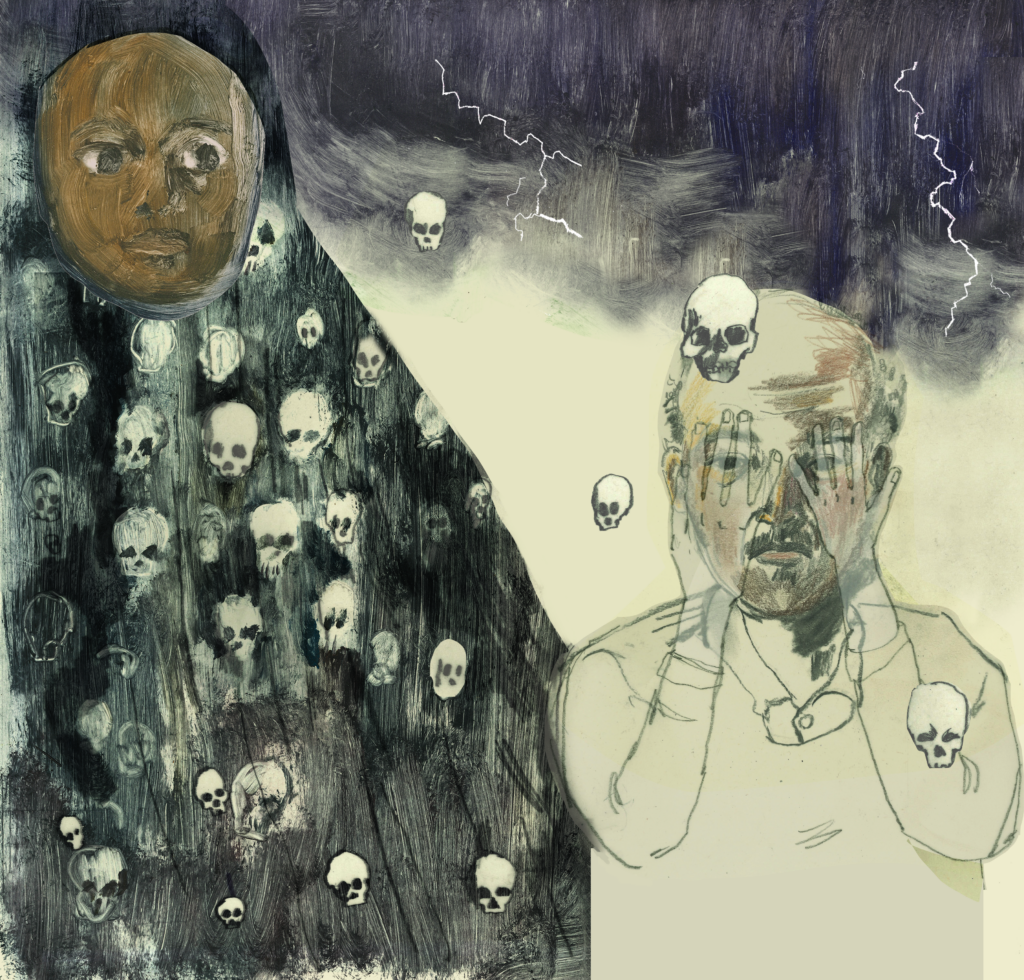
I’m proud of this illustration and I think I did a great job of representing Mugdi and Waliya’s tense relationship. One where he is powerless and haunted by her presence.
In my initial thumbnails, I wanted to represent Waliya as a storm bringing a rain of skulls. I recently read a book called “Determined” by Robert Sapolsky that outlined a pretty good argument against free will. In it, he used the metaphor of a hurricane to describe harmful people. He argues that one cannot be personally upset at a hurricane for destroying their town. It’s an inevitable weather phenomenon and it would be outrageous to direct your frustrations at the hurricane itself. A similar thing could apply to Waliya. Can you be surprised, that a woman who grew up in a refugee camp and lived in an unsafe environment where she were most likely victimised and abused, could be a terrible mother and a crazy person?
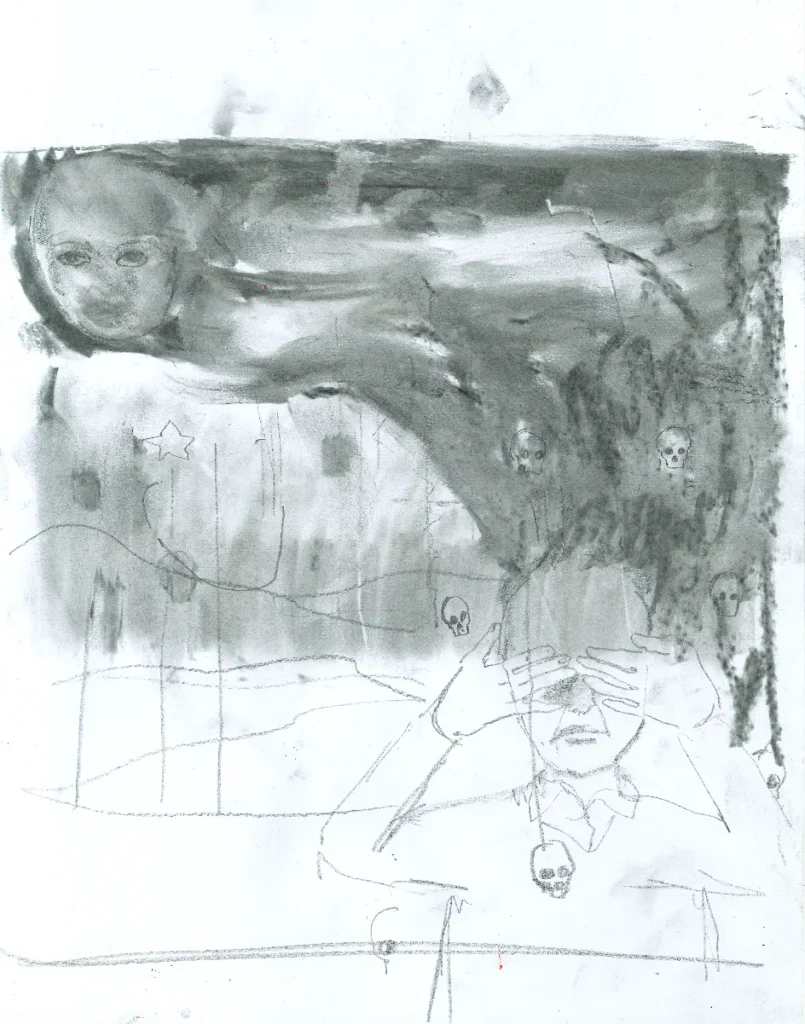
But in the end, I was unable to incorporate her into the storm cloud for design reasons; it just wouldn’t be as strong of a composition. So I ended up incorporating the skulls into her hijab, with a storm in the background. This left me feeling torn. On one hand, I do think the illustration is a good representation of how Mugdi perceived Waliya: a foreboding, evil, veiled figure bringing misfortune to his life. But on the other hand, do I want to create images like this that blatantly portrays a hijabi woman as evil, especially when I use her veil as a visual tool to illustrate her terribleness? When there are so few positive or empathetic representations of them in our media? What responsibility do I have as an illustrator putting this image out in the world?
The Burden of Representation
In his book about Black Cultural Studies “Welcome to the Jungle”, Kobena Mercer has a chapter dedicated to the burden of representation. He begins by describing the critical reception of The Other Story; an exhibition of Black and South Asian British art, the first of its kind in 1989. Although the negative reviews from right-wing critics was expected, the overwhelming disappointment from Black critics was surprising.
Even more surprising, is that the criticism was about “extraartistic issues” (Mercer, 1994, p. 233) such as gender and racism. For example, one of the critiques was that the exhibition was male dominated and therefore sexist. Mercer argues that although that may be true, it is important to understand the cultural context in which a work of art is made, along with the artist’s intentions.
Mercer posits that the frustration was mostly because The Other Story was burdened with the responsibility of “corrective inclusion to counteract such historical exclusion of Black artists in Britain” (1994, p. 233). Black identities are so heterogenous, so how could one exhibition possibly appeal to all the different Black experiences?
The similarities between how I felt about Farah’s book, and how Black critics felt about the exhibition is almost identical. We are both frustrated that the work of art is not completely representative and all-encompassing of our experiences. We both know that the work of art is the first of its kind and we are too impatient to wait for the next one.
Considering the context of North of Dawn (written by a man born in 1945, living in the diaspora) it’s difficult to imagine that it could be any different. Therefore, it’s important to approach the work of art understanding that context, and not to project “extra-artistic” burdens on it.
Conclusion
There has been an effort the past decade or so to have more positive representation in our media when it comes to women and ethnic minorities. That’s probably why this book was so unsettling to me, it was an exercise in representing the absolute worst of something. But that leads to the question: what is good representation? Is it representation that is purely positive and that appeals to the most people? Does that leave space for other conversations that may be uncomfortable but very important? Therefore, my final thoughts about the book were “I didn’t like it, but I’m glad it exists”.
Reading Mercer’s essay after illustrating the book review was really interesting. Is it fair to put the weight of political correctness on a work of art? Instinctively I want to say: yes, it is fair. Especially if the work is given such a large platform. But I realise that pressure may silence or ostracise other worldviews (that although I may disagree with), should be understood and spoken about. It’s a story that’s really difficult, and it bares the ugliness and the consequences of extremism in an unflinching way. My initial reaction to North of Dawn was mostly related to how other people may take the book, rather than what it’s adding to the conversation about fundamentalism within Somali communities. In the end, the potential lack of criticality other readers may have towards this book, is none of my beeswax.
The frustrations I initially had with Farah’s book followed me to my playing card project, and this manifested into an urge to make this project appealing and relatable to all Somalis.
This pressure made me feel stuck and nervous about how to approach the work. I eventually managed to overcome this by framing it as a personal project, rather than an authoritative voice on what is or isn’t Somali diaspora culture. This made the project so much more enjoyable and fulfilling. I’ll make a blog post about the playing cards in the future, once I’ve had a bit of time away from them. I’ll probably have more interesting reflections then.
I’m still forming my thoughts about what representation means to me, and how I want to approach it in my practice. I’m left with more questions than answers.
(Also, I’ve finally figured how to add a newsletter to this blog! Subscribe if you’d like to.)
Mercer, K. (1994) Welcome to the Jungle: New Positions in Black Cultural Studies. Routledge.
this was a banger post indeed. you have influenced me to read North of Dawn (will get back to you on my thoughts).
Really interesting book! Let me know what you think of it after you read it
This was a really engaging and thoughtful blog post. I really liked the discussion about representation espeacially as it’s a hot topic these days and the question of if it matters if it’s ‘good’ or ‘bad’.
Looking forward to the next one!
Thanks, Amina. I miss you!